
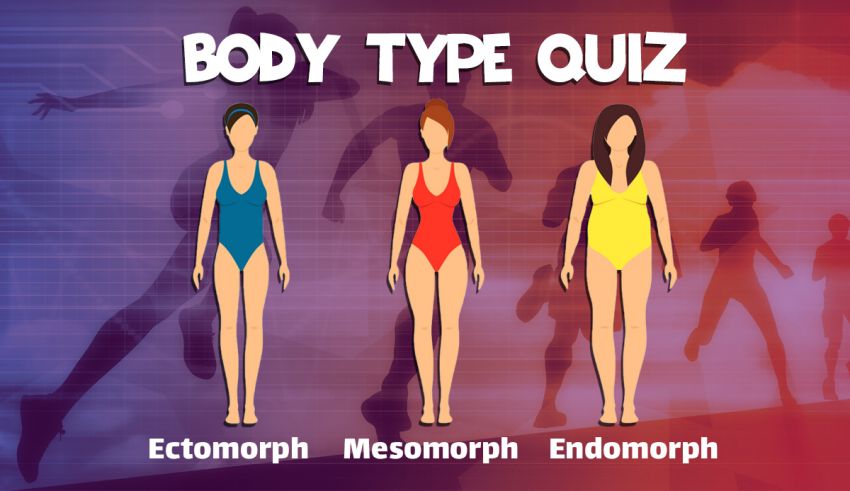
Body Type Quiz: Explore Body Shape Descriptions

This body type quiz uses 15 questions about your shape to suggest a description. Your result is a starting point for self-reflection and fun.

Body Type Quiz

What body type descriptions cover

A body type quiz gives you words for describing your outline. This activity uses your answers about visible shapes to suggest one of four descriptions. It’s for self-reflection and fun, and it cannot assess your metabolism, fitness or health.

Ectomorph, endomorph and mesomorph are labels often called somatotypes. Here, they describe broad patterns in body shape. People can have a mix of those patterns, so the quiz also has a Mixed Description result.

These labels don’t rank bodies. A narrower outline isn’t better than a rounder one, and a muscular-looking shape doesn’t tell you how strong someone is.

How the questions work

The 15 questions ask about the outline of different parts of your body. You’ll describe areas such as your upper arms and torso. Other questions ask about your rib cage from the side or your middle while you’re sitting comfortably.

The quiz uses those choices to suggest a description. Answer based on what you notice about yourself, rather than a shape you’d like to match. When a question asks you to picture yourself as a game character, focus on the shape it names.

Some descriptions might fit only part of your body. Your arms and hips don’t have to fit the same label. Choose the closest answer without treating each choice as an exact measurement.

What the four results mean

Ectomorph

This label is commonly used for a narrower, more slender outline. Read it as a broad description of shape. It doesn’t predict how easily you’ll gain weight or build muscle.

Endomorph

A rounder outline is often described with this label. The word doesn’t explain your eating habits or say anything about your effort. It also doesn’t tell you how your weight might change.

Mesomorph

The mesomorph description generally refers to a more muscular-looking outline. Appearance alone doesn’t measure strength or stamina. This result gives you no reason to assume a particular workout will suit you.

Mixed Description

You might recognize parts of several descriptions in your answers. Mixed Description leaves room for that overlap. You don’t need to squeeze every part of your shape into one category.

Shape labels and styling systems are different

Clothing terms such as rectangle, pear and hourglass describe proportions, often by comparing the shoulders, waist and hips. They aren’t interchangeable with somatotype labels. None of these systems is a universal way to classify everyone.

Kibbe categories are another system, used for styling. If you’re curious about that subject, you can explore the five Kibbe style families as a separate activity. A result here doesn’t assign you a Kibbe category.

Your description can’t tell you what to eat, how to exercise or how healthy you are. It also can’t explain symptoms or changes in your body. A qualified health professional is the person to ask about health concerns.

Leave a Reply

Your email address will not be published. Required fields are marked *

Questions of The Quiz

1
How would you describe the outline of your upper arms?
  • Wider near the shoulders

  • Rounded along both sides

  • Narrow with little change in width

  • Straight sections beside fuller curves

2
When you picture your torso between your shoulders and hips, what stands out about its outline, with clothing ignored?
  • Curves

  • Contrasting shapes

  • Width

  • Length

3
My wrist outline looks similar to the rest of my arm.
  • Mostly, mine stay rounded as they reach my hands

  • Not really, my arms get noticeably wider above my wrists

  • My wrists look narrow, but my arms have both straight and rounded sections

  • Yes, there's only a small change in width

4
Pick the closest description of your rib cage's outline from the side.
  • A narrow profile

  • A full outward curve

  • Broad with a fairly straight edge

  • Straight above, curved below

5
You're drawing yourself as a game character. What would you keep about the shape of your neck?
  • I'd keep the width where it meets the top of my shoulders

  • The contrast between its straighter sides and the curves near its base

  • The rounded outline

  • Its length

6
Your lower legs?
  • Mixed contours

  • Clearly tapered

  • Mostly narrow

  • Rounded

7
How do your thighs look when you're standing comfortably?
  • Pretty straight along the sides

  • I see rounded areas alongside straighter sections

  • Mine have a clear outline that narrows toward my knees

  • I'd draw mine with curved lines

8
You're sitting comfortably in a chair without leaning forward. How does your middle look from the side?
  • Straighter above the waist, with a fuller curve below it when I sit

  • My upper torso looks broad, with a more noticeable change near the waist

  • A shallow profile

  • A rounded outline

9
Choose the line that best matches the outside of your hips.
  • Curved above, straighter farther down

  • An outward angle, then inward

  • A gradual outward curve

  • Nearly straight

10
Along my forearms, I notice...
  • clear edges

  • rounded contours

  • contrasting sections

  • little taper

11
If you look at your legs while they're relaxed and straight, how do your knees compare with the areas around them?
  • There's a curve above my knees and a straighter outline below

  • My thighs and calves look wider, so my knees form a clear dip

  • They blend into the rounded outline around them

  • Mine are close in width to the areas just above and below

12
What shape does your shoulder line make at rest?
  • A broad, fairly level line

  • A short, gentle slope

  • A rounded slope

  • Straight near the neck, curved outward

13
Your ankle outline?
  • Narrow

  • Angular

  • Smoothly curved

  • Partly rounded

14
Compared with my torso, my arms and legs look...
  • relatively short

  • relatively long

  • similar in proportion

  • differently proportioned

15
Which detail looks most like you in a full-body sketch?
  • Rounded edges

  • Long lines

  • I'd need both long, straight lines and fuller curves in different areas

  • The broader upper outline and the clearer angles around my joints